
3 Ways Netflix Can Bounce Back After the Crash
Streaming content pioneer Netflix (NASDAQ: NFLX) is experiencing an incredible fall from grace. The company is struggling in the aftermath of the coronavirus outbreak after initially enjoying a boom. Netflix's stock was trading at $172 per share as of this writing, down from over $600 late in 2021.
Despite the bad news, there are actions Netflix can take to bounce back after the crash. Converting the estimated 100 million free riders into paying members would be a good start. Successfully launching an ad-supported version could spur signups from cost-conscious viewers. Finally, ditching the box-office avoidance strategy would remove a competitive disadvantage.
1. Netflix can stop free users
Shockingly, Netflix management estimates there are 100 million households that are watching its content without paying. It's not surprising that people are sharing their passwords with friends, family, and classmates outside of their homes, but the magnitude of the phenomenon caught some investors off-guard. To put the figure into context, Netflix has 222 million paying subscribers as of March 31. Netflix could almost instantly grow its subscriber base by 45% by getting these free riders to pay.
These are folks who have already proven to enjoy the Netflix service. It's a matter of Netflix developing and implementing the technology to restrict usage to a pre-defined conservative number of devices. If an account can only be registered to four devices, paying members will be more prudent about sharing their login information.
2. A lower-priced, ad-supported tier
Netflix has long been against offering a lower-priced, ad-supported version of its service. However, management acquiesced in its most recent conference call when CEO Reed Hastings said he has changed gears and is planning to launch an ad-supported version as early as this year. This can help the stock recover for a couple of reasons. For one thing, it could boost subscriber and revenue growth as cost-conscious consumers who were on the fence become members. In addition, it could give investors confidence that management is willing to make bold changes when necessary.
The courage to admit your course of action was not ideal -- and change course -- is a desired attribute in leadership. Enterprise has and will always be a dynamic endeavor; stubbornness has rarely paid off in the long run.
3. Release films on the big screen
The company has long ditched the big screen in favor of releasing new films straight to its streaming service. The strategy of not going to the box office blocks Netflix from a lucrative revenue source. For instance, Disney's (NYSE: DIS) Doctor Strange in the Multiverse of Madness has grossed over $932 million at the box office. The film has likely recovered the cost of producing it and then some. It will soon launch on the Disney+ streaming service, which will attract subscribers and help retain existing subscribers.
By ditching the big screen, Netflix does not capture the revenue from theaters. Then it leaves weekends to rivals that get a full measure of benefits from moviegoers. In the last decade alone, Disney has released 25 films to the big screen that have each grossed over $1 billion in ticket sales.
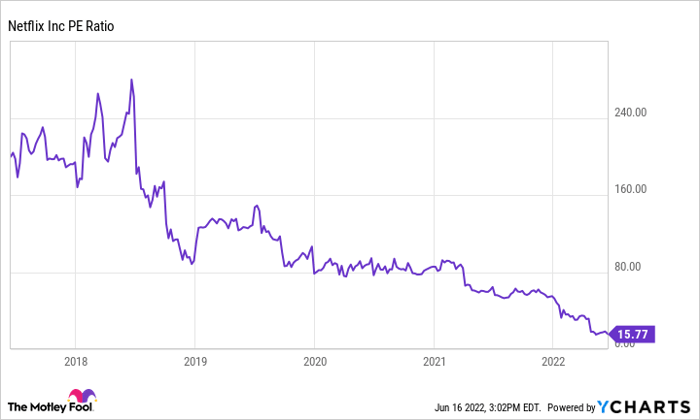
NFLX PE Ratio data by YCharts.
Netflix's pre-pandemic strategies worked well when there was only limited competition. But they're not likely to be as effective as the pandemic subsides. It's encouraging to shareholders that management has indicated a willingness to adapt.
The stock has already paid an incredible price as evidenced by its dramatic fall. At a price-to-earnings ratio of 15.8, it's nearly as cheap as it's been in the last five years. If the company implements the above-mentioned changes, it could well bounce back. Admittedly, the recovery might not be as rapid as the fall.
10 stocks we like better than Netflix
When our award-winning analyst team has a stock tip, it can pay to listen. After all, the newsletter they have run for over a decade, Motley Fool Stock Advisor, has tripled the market.*
They just revealed what they believe are the ten best stocks for investors to buy right now... and Netflix wasn't one of them! That's right -- they think these 10 stocks are even better buys.
*Stock Advisor returns as of June 2, 2022
Parkev Tatevosian has positions in Netflix and Walt Disney. The Motley Fool has positions in and recommends Netflix and Walt Disney. The Motley Fool recommends the following options: long January 2024 $145 calls on Walt Disney and short January 2024 $155 calls on Walt Disney. The Motley Fool has a disclosure policy.
