
3 Green Flags for Meta Platforms' Future
Meta Platforms (NASDAQ: FB), the company formerly known as Facebook, is often pilloried by regulators, privacy advocates, and other tech companies thanks to its business practices and market dominance.
Yet Meta has continued to expand as it's weathered all those controversies. Its stock has nearly tripled over the past five years, even as it dealt with the Cambridge Analytica scandal, the proliferation of hate speech and fake news across its platforms, antitrust fines, and calls to spin off Instagram and WhatsApp into separate companies.
Therefore, investors who were scared into selling their shares of Meta missed out on some big gains. However, it still isn't too late to buy Meta as three green flags appear on the horizon.

Image source: Oculus.
1. A big holiday season for Oculus
In November, Qualcomm's CEO Cristiano Amon said Meta had shipped about 10 million Oculus Quest 2 headsets over the past year. That was an estimate rather than an official number, but it indicated Oculus was getting close to Mark Zuckerberg's goal of reaching ten million virtual reality (VR) users.
That momentum seems to have carried over into the holiday shopping season. KeyBanc analyst Justin Patterson recently pointed out that the Oculus app became one of the five most downloaded iOS apps across over a dozen countries on Christmas Day -- which suggests that a lot of people received the VR headset as a gift.
A strong holiday season should reinforce the Quest 2's dominance of the stand-alone VR headset market. Meta generated less than 3% of its revenue from the "others" segment that sells its Oculus headsets and Portal smart screens last quarter, but the business has been growing much faster than its core advertising business over most of the past year:
|
Revenue Growth (YOY) |
Q3 2020 |
Q4 2020 |
Q1 2021 |
Q2 2021 |
Q3 2021 |
|---|---|---|---|---|---|
|
Advertising |
10% |
31% |
46% |
56% |
33% |
|
Other |
40% |
156% |
146% |
36% |
195% |
|
Total |
11% |
33% |
48% |
56% |
35% |
Source: Meta. YOY = Year-over-year.
That trend could gradually reduce Meta's dependence on its controversial advertising business over the long term.
2. Here comes the metaverse
It's tempting to dismiss Facebook's rebranding as "Meta Platforms" and its subsequent promotion of the "metaverse" as an attempt to divert attention away from the whistleblower scandal that erupted in September.
But if we look at Zuckerberg's previous comments about VR platforms and Oculus' growth over the past year, it makes perfect sense to rebrand the company and shift its focus away from PCs and mobile devices.
With the Quest 2, Meta has established the hardware foundation to expand Horizon Worlds, its VR playground enabling Oculus users to socialize and engage in VR experiences together, as a new computing platform.
Meta is also expanding into the augmented reality (AR) market with its Ray-Ban Stories smart glasses. In addition, it plans to launch a higher-end mixed reality headset, codenamed "Project Cambria", in the near future.
These products will give Meta a first-mover's advantage in the nascent metaverse market, which could blur the lines between the physical and digital worlds on a new computing platform. That reputation could make Meta the top stock to buy for metaverse-oriented investors over the next few years.
3. A flight to quality
Many pandemic-oriented, speculative, overvalued, and unprofitable tech stocks crumbled over the past year. That main culprit is inflation, which is driving interest rates higher and causing investors to rotate toward safer investments.
But if we look at Meta and its FAANG peers -- Amazon (NASDAQ: AMZN), Apple (NASDAQ: AAPL), Netflix (NASDAQ: NFLX), and Alphabet (NASDAQ: GOOG) (NASDAQ: GOOGL) -- we'll see that all five tech giants have generated positive returns this year as other tech stocks have withered:
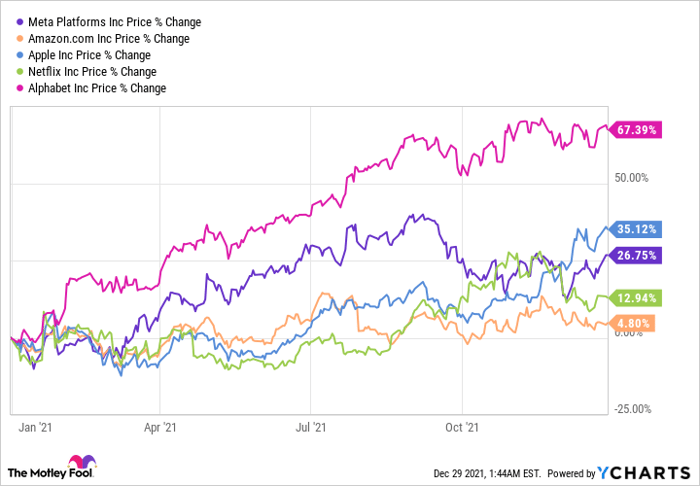
Source: YCharts
That trend indicates investors are still buying higher-quality tech stocks as they dump their pricier and more speculative stocks. If we compare Meta's estimated annual earnings growth rate over the next five years and its PEG ratio to those of its FAANG peers, we'll see just how cheap its stock still is:
|
Company |
Estimated EPS Growth (Next 5 Years) |
PEG Ratio |
|---|---|---|
|
Meta Platforms |
21.4% |
0.91 |
|
Amazon |
36% |
2.05 |
|
Apple |
15.7% |
3.85 |
|
Netflix |
42.6% |
1.49 |
|
Alphabet |
21% |
0.85 |
Source: Yahoo Finance, Dec. 29.
Generally speaking, a PEG ratio under 1.0 is considered undervalued. We should always take analysts' long-term estimates with a grain of salt, but Meta and Alphabet still look much cheaper than their FAANG peers.
Therefore, we could see Meta and Alphabet benefit from a "flight to quality" next year if inflation and interest rates continue to rise.
Betting against Meta is a bad idea
I sold my shares of Meta in early 2021 because I thought it faced too many regulatory and platform-related challenges. However, I clearly underestimated Meta's resilience and its ability to expand and evolve.
Meta still faces plenty of near-term challenges, including an FTC lawsuit and Apple's privacy changes on iOS, but I believe it can weather those challenges and continue to grow. In short, investors shouldn't bet against Meta and the 3.6 billion people who use at least one of its apps each month.
10 stocks we like better than Meta Platforms, Inc.
When our award-winning analyst team has a stock tip, it can pay to listen. After all, the newsletter they have run for over a decade, Motley Fool Stock Advisor, has tripled the market.*
They just revealed what they believe are the ten best stocks for investors to buy right now... and Meta Platforms, Inc. wasn't one of them! That's right -- they think these 10 stocks are even better buys.
*Stock Advisor returns as of December 16, 2021
Suzanne Frey, an executive at Alphabet, is a member of The Motley Fool's board of directors. Randi Zuckerberg, a former director of market development and spokeswoman for Facebook and sister to Meta Platforms CEO Mark Zuckerberg, is a member of The Motley Fool's board of directors. John Mackey, CEO of Whole Foods Market, an Amazon subsidiary, is a member of The Motley Fool's board of directors. Leo Sun owns Amazon and Apple. The Motley Fool owns and recommends Alphabet (A shares), Alphabet (C shares), Amazon, Apple, Meta Platforms, Inc., Netflix, and Qualcomm. The Motley Fool recommends the following options: long January 2022 $1,920 calls on Amazon, long March 2023 $120 calls on Apple, short January 2022 $1,940 calls on Amazon, and short March 2023 $130 calls on Apple. The Motley Fool has a disclosure policy.
