
1 Year After Its IPO, Duolingo Is Proving the Bears Wrong
In July 2021, language-learning mobile-app company Duolingo (NASDAQ: DUOL) made its debut on the public market. Investors were immediately attracted to the company given its high growth, free-cash-flow positivity, and large addressable market. However, I decided not to buy shares, worried about this potentially being a high-churn business.
Now, over one year later, Duolingo is proving the bears (including me) wrong. In the second quarter of 2022, the company reported numbers for paying subscribers that are forcing me to reconsider my bearish thesis. Could Duolingo stock be a good buy after all?
I've been wrong (so far) about Duolingo
Duolingo offers an app to help people learn to speak other languages. The app is monetized with advertising and in-app purchases. But people can also pay for a subscription to keep it ad-free and unlock other features.
I've doubted the viability of an investment in this space more than I've doubted Duolingo itself. People learn languages for finite time periods. This differs from a subscription to an app for mental health, for example. Theoretically, if you're willing to prioritize your mental health today, you'll be willing to continue prioritizing it for a long time, consequently keeping your subscription to the app.
If I want to learn Italian, I might use Duolingo. After a few years, I'll either be successful or I won't. But either way I'm not going to study Italian indefinitely, meaning it makes sense to eventually drop my Duolingo subscription. By contrast, a consumer might keep their Netflix subscription for as long as they enjoy the ever-updating content library. It's the subtle difference between a learning subscription and an entertainment subscription.
This is why I believed Duolingo's growth would eventually stall out. But in Q2, Duolingo continued a streak that I was sure sure would've ended by now. Its paying subscriber count continues to tick higher, as the table below of the last six quarters demonstrates.
| Metric | Q1 2021 | Q2 2021 | Q3 2021 | Q4 2021 | Q1 2022 | Q2 2022 |
|---|---|---|---|---|---|---|
| Paying subscriber total | 1.8 million | 1.9 million | 2.2 million | 2.5 million | 2.9 million | 3.3 million |
| Paying subscriber percentage of total user base | 4.8% | 5.1% | 5.5% | 6.2% | 6.8% | 7.2% |
Source: Duolingo Q2 letter to shareholders.
Even if Duolingo users are dropping their subscriptions after achieving their language-learning goals, as I assumed, the company is replacing them faster than they're leaving. That's not something I expected to happen consistently and it's proving my core assumptions wrong.
Could Duolingo stock be a buy?
Paying-subscriber growth is a big deal for Duolingo. While paying subscribers make up only 7.2% of its user base, these subscribers accounted for 74% Duolingo's revenue in Q2. That's a trend unlikely to change in coming years. Therefore paying-subscriber growth is paramount for overall revenue growth.
With paying subscribers up 71% year over year in Q2, investors may be inclined to think that Duolingo stock is a no-brainer buy. But there is an important caveat to Duolingo's growth. Its sales-and-marketing expenses are going up almost as fast as revenue, as the chart below shows.
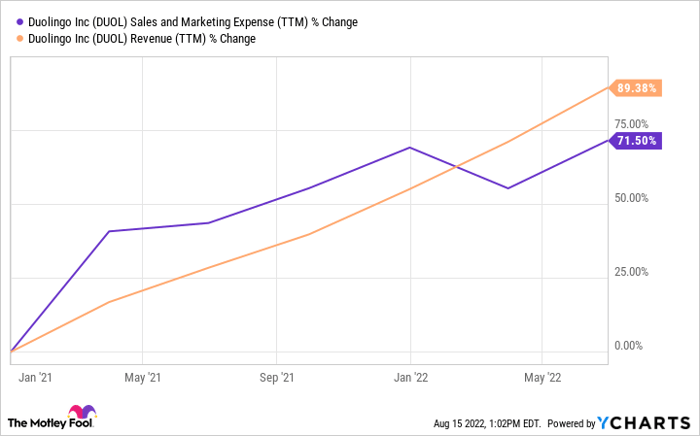
DUOL Sales and Marketing Expense (TTM) data by YCharts
Duolingo's ongoing paying-subscriber growth is admirable. However, the company is having to pay for this growth. This could imply that if management cuts back on this expense, then its growth would stall. In other words, it might never gain substantial operating leverage in this area.
The big question, therefore, is whether the lifetime value of Duolingo users is enough, considering its current cost to acquire users. Unfortunately, management doesn't break out its customer acquisition costs or the average lifespan of a Duolingo subscription. Investors might want to give the company the benefit of the doubt, however. Everything the company does is A-B tested so that all decisions can be data-driven. And this includes its user-acquisition spend.
In the conference call to discuss Q2 results, CEO Luis von Ahn said, "Whenever we do the experiments, we really try to see that they actually increase the lifetime value of users." Therefore, it's clearly something the company is thinking about even if investors aren't always privy to all the details.
For the moment, revenue growth is outpacing marketing spend for Duolingo. It could be a short-term anomaly, but it could also be the result of diligent experiments by management. The latter is a replicable process that could be applied to many other aspects of the business to improve operations. That's big.
I'm still in wait-and-see mode with this stock. But a quarter or two more of paid-subscriber growth may finally be enough to convince me its results are the product of management's process, giving me confidence in the company's long-term viability.
10 stocks we like better than Duolingo, Inc.
When our award-winning analyst team has a stock tip, it can pay to listen. After all, the newsletter they have run for over a decade, Motley Fool Stock Advisor, has tripled the market.*
They just revealed what they believe are the ten best stocks for investors to buy right now... and Duolingo, Inc. wasn't one of them! That's right -- they think these 10 stocks are even better buys.
*Stock Advisor returns as of July 27, 2022
Jon Quast has no position in any of the stocks mentioned. The Motley Fool has positions in and recommends Netflix. The Motley Fool has a disclosure policy.
