
1 Sleeper Stock That Could Win Big in 2023
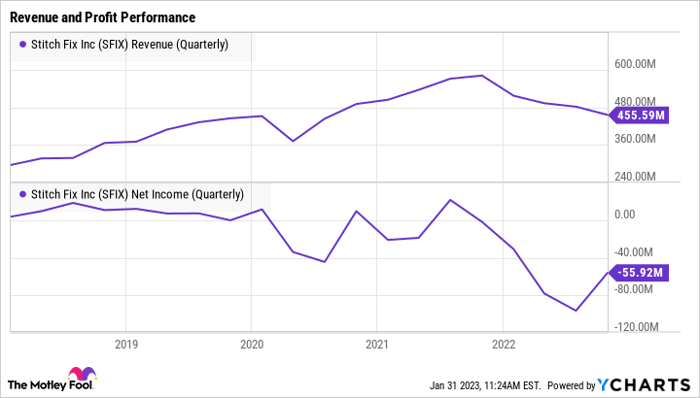
It's been a rough stretch for leading styling service Stitch Fix (NASDAQ: SFIX). The stock fell 69% after reporting worsening revenue trends over the last year. Revenue hit a peak of $581 million in the fiscal first quarter of 2022 before tumbling to $456 million in the most recent quarter.
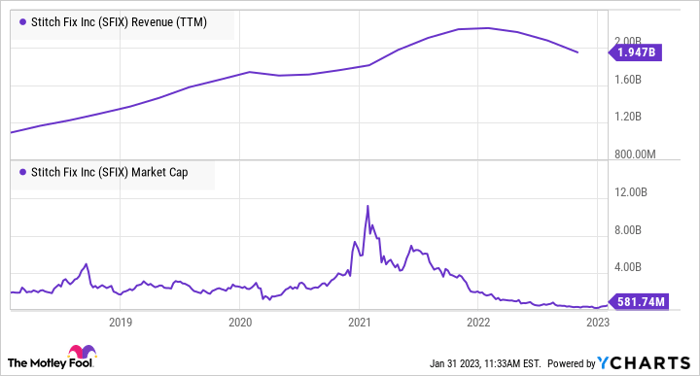
I sold my holding in the stock last year after the company's performance started getting worse with no catalysts for a turnaround. But I recently bought the stock again -- it's fallen to a low market cap (stock price times shares outstanding) of less than $500 million, which I believe significantly undervalues the long-term potential of the business.
Stitch Fix's styling service is too valuable to consumers for the market to value it this cheaply. Moreover, the return of founder Katrina Lake as interim CEO is a big step in turning the business around. Here's why the stock could rebound sharply in 2023.
What the market is missing
Stitch Fix entered the year performing well. Revenue grew 19% year over year in the fiscal first quarter of 2022 ending in October of calendar 2021, so it's not like this is a floundering business that has never proven it can grow. But Stitch Fix was hit hard by rising inflation and lower retail spending. In December, early estimates for retail and food services spending were down 1.1% from November, according to the U.S. Census Bureau. Against that economic backdrop, the company's revenue decline is not as bad as it would be if retail spending were growing.
Data by YCharts
Stitch Fix also experienced onboarding issues with new clients after rolling out its Freestyle service in 2021, but overall Stitch Fix would be reporting better numbers if consumer spending were stronger across the board.
However, one negative is that Stitch Fix's active client base is down 11% compared to 2021. It's good to see spending per active client remaining stable at $525, but in the last earnings report management said customer spending was showing signs of slowing.
The loss of customers put greater pressure on the company's profitability. Before the pandemic, management was investing in growth while keeping the business at breakeven. But the decline in revenue took the company's net loss down to almost $56 million in the last quarter, which it can't afford.
The good news is that Stitch Fix has a strong balance sheet. It ended the fiscal first quarter in October with $208 million in cash and investments and no debt. It's still important for the company to get back to breakeven on a free cash flow basis to stop the bleeding, but that's why a healthy balance sheet is invaluable right now, as it buys management time to turn things around.
On that note, Lake announced that the company would close its distribution facility in Salt Lake City and layoff about 20% of its salaried workforce. These moves are unfortunate, but should go a long way to firming up the company's bottom line.
The upside is massive
The long-term upside off these lower share prices could be tremendous. A return to profitability is something that management should be able to get done, which would get the stock moving higher this year.
For example, the online home goods brand Wayfair has seen its stock nearly double year to date, as the market anticipates improving profitability in the near term. The company recently announced new efforts to optimize its cost structure after being in a similar situation as Stitch Fix, with declining revenue and widening losses.
Stitch Fix trades at a very low price-to-sales (P/S) ratio of 0.27, lower than Wayfair's P/S multiple of 0.50, while the average stock in the S&P 500 index trades at more than 2 times sales. A market cap of $443 million screams deep value for a company reporting more than $2 billion in annual revenue just over a year ago.
Data by YCharts
Stitch Fix's proprietary data and recommendation algorithms don't get enough attention. Customers rate specific items and outfits with a thumbs up or thumbs down, similar to how viewers rate shows on Netflix. The company gathers that feedback and very quickly learns each client's style preference. And Stitch Fix adds further value by also using actual stylists that add a human touch to each Fix.
There is tremendous value in what Stitch Fix is offering. Two factors that should help the stock move higher from here are the company's debt-free balance sheet and founder Katrina Lake, who controls nearly 30% of the company through class B common stock, returning as interim CEO to help select a new leader. There are positive changes underway that could see the stock rebound in 2023.
10 stocks we like better than Stitch Fix
When our award-winning analyst team has a stock tip, it can pay to listen. After all, the newsletter they have run for over a decade, Motley Fool Stock Advisor, has tripled the market.*
They just revealed what they believe are the ten best stocks for investors to buy right now... and Stitch Fix wasn't one of them! That's right -- they think these 10 stocks are even better buys.
*Stock Advisor returns as of January 9, 2023
John Ballard has positions in Netflix and Stitch Fix. The Motley Fool has positions in and recommends Netflix and Stitch Fix. The Motley Fool recommends Wayfair. The Motley Fool has a disclosure policy.
